On-Page vs. Off-Page SEO: A Comprehensive Guide for Pakistani Businesses
Imagine you’ve just opened a fantastic new store in a busy Lahore market. You’ve meticulously arranged your products, polished the floors, and created beautiful, clear signage. That’s your On-Page SEO. Now, imagine you have glowing reviews in local publications, other popular shop owners are recommending you, and your name is the talk of the town. That’s your Off-Page SEO.
In the bustling digital marketplace of Pakistan, getting your website noticed on Google is just as crucial as having a prime physical location. Search Engine Optimisation (SEO) is the key to unlocking that visibility. But SEO isn’t a single magic trick; it’s a strategy built on two core pillars: On-Page and Off-Page SEO. Understanding the difference between these two is the first step towards dominating search engine results and driving meaningful traffic to your business.
This guide will demystify these two concepts, explaining what they are, why they matter, and how they work together to create a powerful, holistic SEO strategy that helps your business thrive online.
What is On-Page SEO? The Foundation of Your Digital Presence
On-Page SEO (also known as on-site SEO) refers to all the optimisation practices you implement directly on your website to improve its position in search rankings. You have 100% control over these factors. It’s about making your website’s content and structure clear and valuable for both search engines like Google and human visitors.
Think of it as ensuring your house is in perfect order before inviting guests. A well-optimised page helps Google understand what your content is about, indexing it correctly for relevant search queries made by users across Pakistan.
Key Elements of On-Page SEO
High-Quality, Relevant Content
Content is the heart of On-Page SEO. Without valuable content, nothing else matters. For a Pakistani audience, this means creating blog posts, service pages, and product descriptions that are original, informative, engaging, and directly address their needs and pain points. Your content should be the best answer to a user’s query.
- Relevance: Does your content match the search intent of your target keywords?
- Comprehensiveness: Does it cover the topic in sufficient detail?
- Originality: Is it unique content, not copied from another source?
Keyword Research and Optimisation
Before you can rank, you need to know what your potential customers are searching for. Keyword research is the process of identifying the terms and phrases people in Pakistan use when looking for your products or services. Once you have your target keywords, you must strategically and naturally integrate them into your website’s content, including:
- Title Tags
- Meta Descriptions
- Headings (H1, H2, H3)
- Body Paragraphs
- Image Alt Text
Title Tags and Meta Descriptions
The Title Tag is the clickable headline that appears in the search results. It’s a critical factor for both SEO and user click-through rates. The Meta Description is the short snippet of text below the title, providing a brief summary of the page. While not a direct ranking factor, a compelling meta description entices users to click on your link over a competitor’s.
Header Tags (H1, H2, H3)
Headers structure your content, making it easier for users to read and for search engines to understand the hierarchy of your information. Your main title should be an H1 tag. Sub-topics should be broken down using H2 tags, and further sub-points with H3 tags. This creates a logical flow and improves the user experience.
Image Optimisation
Images can slow down your website, which is a major negative for SEO. Optimising images involves compressing them to reduce file size without sacrificing quality and using descriptive alt text. Alt text helps search engines understand what an image is about and makes your site more accessible to visually impaired users.
Internal Linking
Internal linking is the practice of linking to other relevant pages within your own website. It helps search engines discover more of your content, distributes “link equity” (ranking power) throughout your site, and keeps users engaged by guiding them to other useful information.
What is Off-Page SEO? Building Authority and Trust
Off-Page SEO includes all the activities you and others do away from your website to raise its authority and reputation. These actions signal to search engines that your website is trustworthy, important, and a valuable resource. It’s essentially about building your brand’s credibility across the web.
Returning to our store analogy, Off-Page SEO is the word-of-mouth marketing, the positive customer reviews, and the favourable mentions that build your reputation in the community and drive new customers to your door.
Key Elements of Off-Page SEO
Backlinks (Link Building)
This is the cornerstone of Off-Page SEO. A backlink is a link from another website to yours. Google views backlinks as “votes of confidence.” However, not all votes are equal. The goal is to earn high-quality backlinks from authoritative and relevant websites. A single backlink from a major Pakistani news publication like Dawn or a respected industry blog is worth more than hundreds of links from low-quality, spammy sites.
Effective link-building strategies include:
- Guest Blogging: Writing articles for other websites in your niche.
- Creating Shareable Assets: Developing unique research, infographics, or tools that people naturally want to link to.
- Digital PR: Reaching out to journalists and bloggers with compelling stories about your brand.
Local SEO (Google Business Profile)
For any business serving a local Pakistani market—be it a restaurant in Karachi or a service provider in Islamabad—Local SEO is non-negotiable. A huge part of this is optimising your Google Business Profile (GBP). This involves ensuring your business name, address, and phone number (NAP) are accurate, adding photos, responding to reviews, and using Google Posts to keep customers updated. Positive reviews on your GBP are a powerful trust signal.
Social Media Marketing
While social media shares are not a direct ranking factor, a strong social media presence on platforms like Facebook, Instagram, and LinkedIn helps build brand awareness and drives traffic to your website. When your content is shared widely, it increases the chances of it being seen by someone who might link to it from their own website, thus indirectly supporting your link-building efforts.
Brand Mentions
Even when a website mentions your brand name without linking to you, Google can still pick up on it. These “unlinked mentions” contribute to your overall brand authority. The goal is to get people talking about your brand online in a positive context.
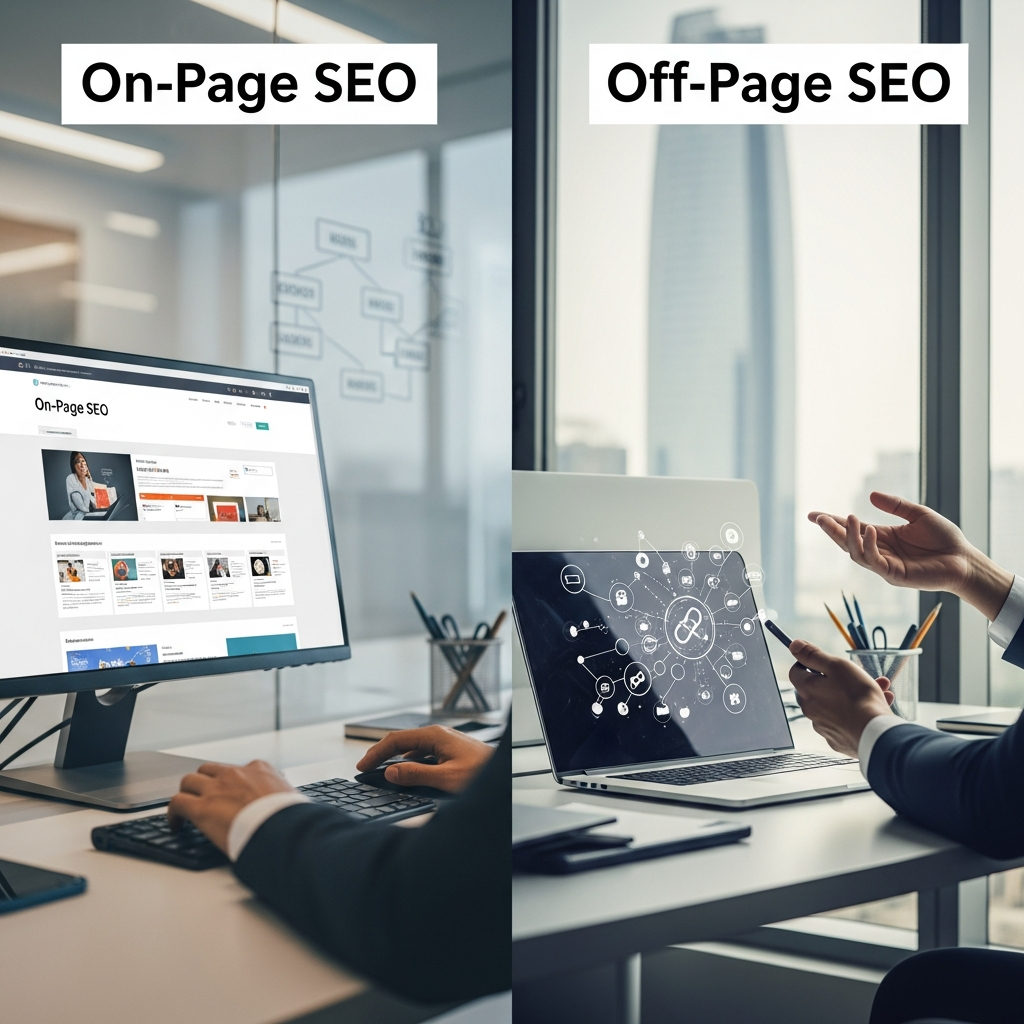
On-Page vs. Off-Page SEO: The Key Differences Summarised
While they work together, it’s helpful to see their core differences side-by-side.
- Focus: On-Page SEO focuses on optimising the content and structure of your website. Off-Page SEO focuses on building the authority and reputation of your website across the internet.
- Control: You have full control over On-Page factors. You have less direct control over Off-Page factors, as they depend on the actions of third parties (e.g., other site owners linking to you).
- Implementation: On-Page activities happen on your site (e.g., writing a blog post). Off-Page activities happen off your site (e.g., earning a backlink).
Why You Need Both: A Symbiotic Relationship
It’s a common mistake to ask whether On-Page or Off-Page SEO is more important. The truth is, they are two sides of the same coin. An effective SEO strategy requires a balanced and integrated approach.
Imagine you spend months on a brilliant Off-Page SEO campaign, earning incredible backlinks from top-tier websites. Users flock to your site, only to find it slow, difficult to navigate, and with thin, unhelpful content. They will leave immediately, and all your hard work will be wasted. Your high bounce rate will signal to Google that your site isn’t a good result, hurting your rankings.
Conversely, you could have the most perfectly optimised website in the world (perfect On-Page SEO), but if no one is linking to it or talking about it, Google will have no reason to see it as an authority. It will struggle to rank for competitive terms against websites with strong backlink profiles.
Excellent On-Page SEO makes your website worthy of ranking, while excellent Off-Page SEO provides the authority needed to actually achieve that ranking.
Frequently Asked Questions (FAQ)
Which is more important, On-Page or Off-Page SEO?
Both are critically important for a successful strategy. However, you should always start with On-Page SEO. Building a strong, well-optimised foundation is the necessary first step before you begin building its authority through Off-Page efforts.
How long does it take to see SEO results in Pakistan?
This varies greatly depending on your industry’s competitiveness, your budget, and the state of your website. You can often see the impact of On-Page changes within a few weeks to a couple of months. Off-Page SEO, especially building a quality backlink profile, is a long-term strategy, and it can take 6-12 months to see significant results.
Can I do SEO myself?
Business owners can certainly learn and implement basic On-Page SEO, such as writing quality content and optimising title tags. However, technical SEO and Off-Page strategies like link building are complex and time-consuming. Missteps, particularly with link building, can lead to Google penalties. For sustained growth, partnering with an SEO specialist is often the most effective approach.
Is link building still relevant in 2024?
Absolutely. Backlinks from high-quality, relevant websites remain one of Google’s most powerful ranking factors. The strategy has evolved from quantity to quality. The focus now is on earning natural links that provide real value, not just accumulating links from anywhere.
How does Local SEO fit into this?
Local SEO is a specialized subset of SEO that uses both On-Page and Off-Page strategies. Creating location-specific service pages (e.g., “Web Design Services in Karachi”) is an On-Page tactic. Optimising your Google Business Profile, building local citations, and getting reviews from local customers are all powerful Off-Page tactics.
Conclusion: The Path to SEO Success
Understanding the distinction between On-Page and Off-Page SEO is fundamental to building a winning online presence. On-Page SEO sets the stage by ensuring your website is a high-quality, user-friendly resource. Off-Page SEO then builds on that foundation, broadcasting your authority and trustworthiness to the world. For businesses in Pakistan, ignoring one in favour of the other is like trying to clap with one hand. True, sustainable ranking success comes from a cohesive strategy that masterfully blends both.
Feeling overwhelmed? Navigating the world of SEO can be complex, but you don’t have to do it alone. At Bloom & Brew, we specialize in crafting comprehensive SEO strategies tailored for businesses in Pakistan. Contact us today for a free consultation and let’s help your business bloom online.