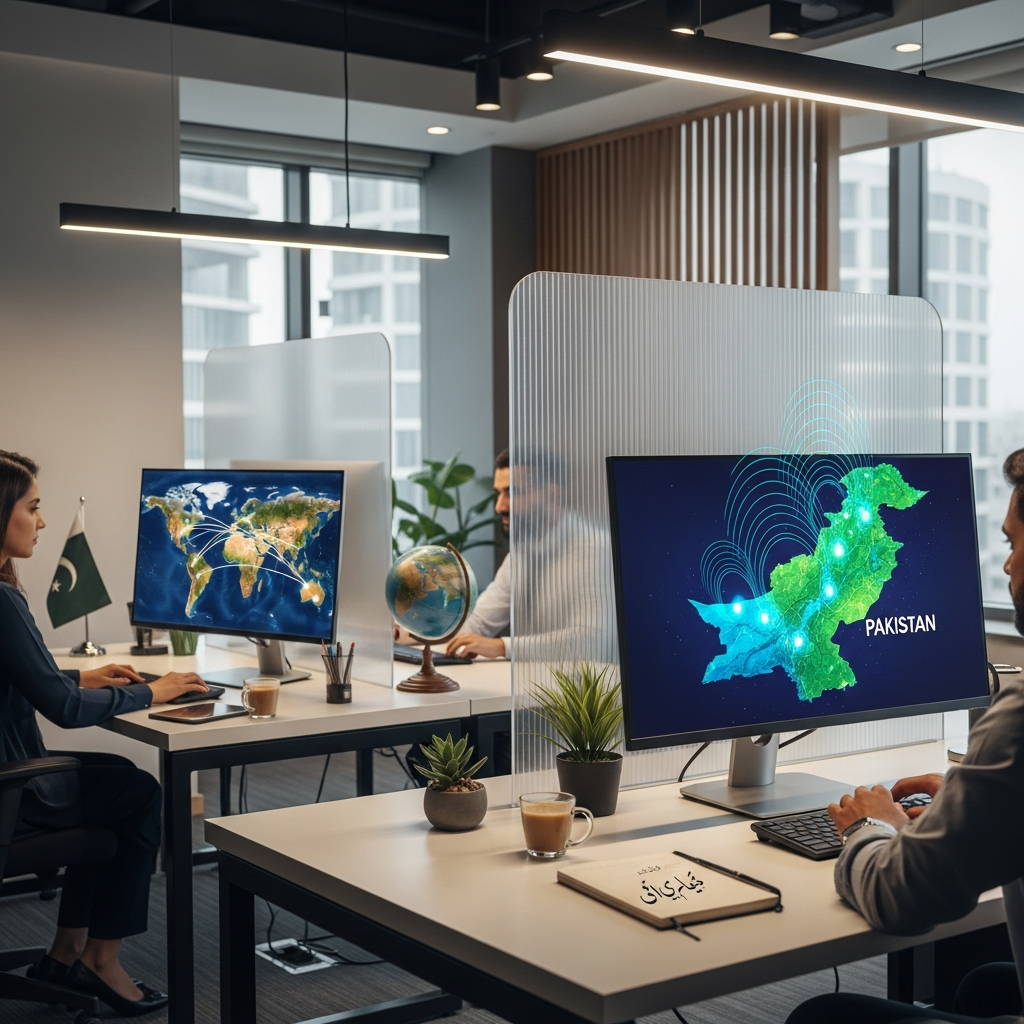
Local SEO vs Global SEO: Which Strategy is Right for Your Pakistani Business?
In Pakistan’s rapidly expanding digital landscape, having an online presence is no longer a choice—it’s a necessity. But simply having a website isn’t enough. The real challenge is getting found by the right customers. Do you want to be the most popular coffee shop in Lahore, or do you want to sell your handcrafted leather goods to customers in London and Dubai? Your answer to this question lies at the heart of a crucial marketing decision: choosing between Local SEO and Global SEO.
Search Engine Optimization (SEO) is the art and science of getting your website to the top of Google’s search results. However, not all SEO is created equal. The strategy you’d use to attract a customer searching for “best biryani in Karachi” is fundamentally different from the one targeting someone searching for “outsource software development.”
This guide will demystify the two powerful arms of SEO. We’ll break down what Local and Global SEO are, who they’re for, and how you can choose the right strategy to help your Pakistani business not just survive, but thrive online.
Diving Deep into Local SEO: Winning Your Neighbourhood
Imagine your business is a well-loved dukan in a bustling local bazaar. Everyone in the neighbourhood knows you, trusts you, and comes to you first. Local SEO is the digital equivalent of that reputation. It’s about making your business the most visible and credible option for customers in your specific geographic area.
What is Local SEO?
Local SEO is a strategy that optimizes your online presence to attract more customers from relevant local searches on Google and other search engines. These are searches that have a geographic intent, even if the user doesn’t explicitly type a location. When someone searches for “car repair near me” or “dentist in Gulberg,” Google knows they’re looking for a local solution and prioritizes businesses in that area.
The goal is to appear in Google’s “Local Pack” (the map with three business listings at the top of the results) and in the regular organic search results for local queries.
Who Needs Local SEO?
If your business serves customers in a specific city, town, or neighbourhood, Local SEO is your bread and butter. This includes:
- Brick-and-Mortar Businesses: Restaurants, cafes, retail stores, clinics, salons, and law firms with physical locations where customers visit (e.g., a boutique in Zamzama, Karachi or a café in F-7, Islamabad).
- Service-Area Businesses: Professionals who travel to their customers, such as plumbers, electricians, event planners, and catering companies serving a specific region like the Lahore metropolitan area.
Key Strategies for Local SEO in Pakistan
Optimizing for local search requires a specific set of tactics tailored to your community.
- Google Business Profile (GBP) Optimization: Your GBP is the single most important tool for Local SEO. It’s the free business listing that appears in Google Maps and the Local Pack. Claim and fully optimize your profile with your correct business name, Pakistani address, local phone number, hours of operation, photos, services, and a compelling description.
- Local Keyword Research: Instead of targeting broad terms like “fashion,” focus on geo-specific keywords. For example, “women’s clothing boutique in DHA Lahore” or “best digital marketing agency in Karachi.” Think about how your local customers search.
- NAP Consistency: Ensure your Name, Address, and Phone number are identical across your website, GBP, and other online directories like PakPages. Inconsistencies can confuse search engines and harm your ranking.
- Encourage Customer Reviews: Positive reviews are a powerful local ranking factor. Encourage your satisfied customers to leave feedback on your Google Business Profile. Respond to all reviews—both positive and negative—to show you value customer feedback.
- Local Link Building: Earn backlinks from other local websites. This could include a local news blog, a community event you sponsored, or a business association in your city. These local “votes of confidence” tell Google you’re a legitimate and relevant part of the community.
Conquering the World with Global SEO
If your ambition extends beyond your city’s borders and across the oceans, then you need to think bigger. Global SEO is your passport to the international market, designed for businesses whose customers could be anywhere in the world.
What is Global SEO?
Global SEO (also known as International SEO) is the practice of optimizing your website to attract organic traffic from different countries and languages. It’s about ensuring that no matter where your potential customers are searching from—be it New York, Sydney, or Riyadh—they can find your products or services.
This strategy is far more complex than Local SEO, as it involves navigating different cultures, languages, and search engine behaviours across the globe.
Who Needs Global SEO?
Global SEO is essential for businesses that are not restricted by geography. This includes:
- E-commerce Stores: Businesses that sell and ship products internationally, such as a Pakistani brand selling high-quality textiles or sports equipment to a global customer base.
- SaaS (Software as a Service) Companies: Tech companies offering software solutions to users anywhere in the world.
- Digital Service Providers: Pakistani software houses, creative agencies, and consultants offering services like web development, content writing, or BPO to international clients.
- Content Creators and Publishers: Bloggers, news outlets, and media companies with an audience that spans multiple countries.
Key Strategies for Global SEO
Taking your SEO strategy international requires a sophisticated approach.
- International Keyword Research: A keyword that’s popular in Pakistan might not be in the UK or the US. You must research search volumes and user intent for each target market. For example, “trousers” is common in the UK, while “pants” is used in the US.
- Hreflang Tags: These are code snippets that tell search engines which version of a page to show to a user based on their language and location. If you have versions of your website in English, Arabic, and French, `hreflang` tags ensure the right user sees the right page.
- International Website Structure: You need to decide how to structure your site for different regions. Options include using country-code top-level domains (ccTLDs) like `yourbrand.co.uk`, subdomains like `uk.yourbrand.com`, or subdirectories like `yourbrand.com/uk/`. Each has its own SEO pros and cons.
- Content Culturalization: It’s not just about translation; it’s about culturalization. Your content, imagery, and marketing messages must resonate with the cultural norms of each target audience. This includes using the correct currencies, date formats, and local idioms.
- Global Link Building: Just as local links build local authority, links from authoritative websites in your target countries build international credibility. Earning a backlink from a major tech blog in the US is a huge signal to Google that you are a relevant player in that market.
Local SEO vs. Global SEO: A Head-to-Head Comparison
To put it simply, here’s a breakdown of the core differences:
- Target Audience:
- Local SEO: Customers in a specific city or region (e.g., Islamabad).
- Global SEO: Customers across multiple countries and languages.
- Keywords:
- Local SEO: Geo-targeted keywords (e.g., “rooftop restaurant in Karachi”).
- Global SEO: Broad, language-specific keywords (e.g., “project management software”).
- Primary Tools:
- Local SEO: Google Business Profile, local directories, customer reviews.
- Global SEO: `hreflang` tags, ccTLDs, international keyword tools.
- Content Focus:
- Local SEO: Content relevant to the local community, events, and news.
- Global SEO: Content with universal appeal, translated and culturalized for different regions.
- Core Goal:
- Local SEO: Drive foot traffic, local phone calls, and website visits from nearby customers.
- Global SEO: Build global brand awareness, drive traffic from multiple countries, and generate international leads/sales.
The Hybrid Approach: Can a Business Use Both?
Absolutely! The two strategies are not mutually exclusive. Many successful Pakistani businesses employ a hybrid approach. Consider a fashion designer based in Lahore. They have a flagship store where they want to attract local shoppers (Local SEO). Simultaneously, they run an e-commerce website that ships their collections worldwide (Global SEO).
In this scenario, they would optimize their Google Business Profile and build local citations to dominate Lahore’s search results. At the same time, they would use `hreflang` tags, target international keywords, and build a global backlink profile to attract customers from the UAE, UK, and USA.
Choosing the Right Path for Your Business
So, which path should you take? The answer depends entirely on your business model and goals. Ask yourself these critical questions:
- Where are my customers? Are they within a 20-kilometre radius, or could they be anywhere on the planet?
- Do I have a physical location? If customers need to visit you, Local SEO is non-negotiable.
- Do I sell products or services online without geographic restrictions? If yes, Global SEO is your key to growth.
- What is my ultimate business ambition? Do you want to be a local champion or an international player?
For most small businesses in Pakistan, starting with a strong Local SEO foundation is the most logical and cost-effective first step. Once you’ve conquered your local market, you can then scale your ambitions and explore a global strategy.
Whether you’re aiming to be the go-to spot in your neighbourhood or a recognized name across continents, the right SEO strategy is your launchpad. The digital world is full of opportunities, and with a clear focus, your business can capture its perfect audience. At Bloom & Brew, we specialize in crafting tailored SEO solutions that align with the unique goals of Pakistani businesses. We understand the nuances of both the local bazaar and the global marketplace.
Ready to find out which SEO strategy will make your business bloom? Get in touch with us today for a free consultation!
Frequently Asked Questions (FAQ)
1. How long does it take to see results from Local SEO in Pakistan?
While some quick wins like optimizing your Google Business Profile can show results in a few weeks, a comprehensive Local SEO strategy typically takes 3-6 months to build significant momentum. Factors like your industry’s competitiveness, your location (e.g., Karachi vs. a smaller city), and the consistency of your efforts all play a role. SEO is a marathon, not a sprint.
2. Is Global SEO more expensive than Local SEO?
Generally, yes. Global SEO is more complex and resource-intensive. It involves managing multiple languages, creating much more content, technical implementations like `hreflang` tags, and building a more diverse and authoritative backlink profile. The scope is simply much larger, which usually translates to a higher investment.
3. I run an online-only business from Pakistan. Do I need Local SEO?
It depends. If you’re a freelancer or an e-commerce store that serves the entire country, you might focus more on National SEO (a strategy that sits between Local and Global). However, if your online business still has a service area, even if it’s large (e.g., “wedding photography in Punjab”), then elements of Local SEO are still very relevant. If you serve clients globally, then Global SEO is your priority.
4. What is the single most important factor for Local SEO success?
While many factors are important, a fully optimized and active Google Business Profile (GBP) is arguably the most critical element. It’s your digital storefront on Google Search and Maps. A well-maintained GBP with accurate information, frequent posts, good photos, and a steady stream of positive reviews can have a massive impact on your local visibility.
5. Can I do Global SEO with a .com.pk domain?
Yes, you can, but it can be more challenging. A `.com.pk` domain strongly signals to search engines that your business is primarily focused on Pakistan. While you can use tools like `hreflang` tags and subdirectories to target other countries, users and search engines in those regions might have a slight preference for a generic TLD (`.com`) or their own country-code TLD (e.g., `.co.uk`). For a serious global push, a `.com` domain is often the recommended choice.