Beyond the Digital Brochure: Top Features Every Modern Business Website Needs in Pakistan
In today’s hyper-connected world, your website is no longer just an online business card; it’s your digital headquarters, your 24/7 salesperson, and often the very first interaction a potential customer has with your brand. For businesses in Pakistan, a dynamic and powerful online presence isn’t a luxury—it’s a fundamental necessity for growth and credibility. Gone are the days of static, ‘set-it-and-forget-it’ websites. A modern business website must be a strategic tool, meticulously engineered to attract, engage, and convert visitors into loyal customers.
But what separates a simple online placeholder from a high-performing digital asset? It’s a combination of strategic design, robust technology, and a deep understanding of user behaviour. Whether you’re a startup in Karachi, a manufacturer in Faisalabad, or a service provider in Lahore, incorporating the right features into your website can be a game-changer. Let’s explore the essential components that every modern business website should have to thrive in the Pakistani market.
Foundational Must-Haves: The Non-Negotiables
Before we dive into advanced features, let’s cover the absolute essentials. These are the pillars upon which a successful website is built. Neglecting any of these is like building a house on a shaky foundation—it simply won’t stand the test of time.
Flawless Responsive Design (Mobile-First Approach)
Think about how you browse the internet. Chances are, you’re often using your smartphone. Your customers are no different. With a massive and growing number of mobile internet users in Pakistan, a mobile-first approach is non-negotiable. Responsive design ensures that your website looks and functions perfectly on any device, from a large desktop monitor to a tablet or a smartphone screen.
A responsive website automatically adjusts its layout, images, and text to fit the screen size, providing an optimal viewing experience for everyone. More importantly, Google now uses mobile-first indexing, meaning it primarily looks at the mobile version of your website for ranking and indexing. A site that isn’t mobile-friendly is not only frustrating for users but is also actively penalised by the world’s largest search engine.
Iron-Clad Security (HTTPS & SSL)
Have you ever noticed the little padlock icon next to a website’s URL in your browser? That’s a sign of a secure connection, enabled by an SSL (Secure Sockets Layer) certificate. This technology encrypts the data exchanged between a user’s browser and your website, protecting sensitive information like passwords, contact details, and credit card numbers.
In an age of increasing cyber threats, security is paramount for building trust. When visitors see that your site is secure (indicated by “https://” instead of “http://”), it gives them the confidence to interact with your business. Browsers like Google Chrome will even display a “Not Secure” warning on sites without SSL, which can instantly deter potential customers. For any business, especially e-commerce stores, SSL is an absolute must-have for credibility and data protection.
Lightning-Fast Loading Speed
Patience is a virtue, but it’s one that online users rarely have. Studies consistently show that if a webpage takes longer than three seconds to load, a significant percentage of visitors will abandon it. A slow website is one of the quickest ways to lose a potential customer to a competitor.
Website speed is a critical factor for both user experience and SEO. Google’s Core Web Vitals prioritize websites that offer a smooth and fast experience. Key factors that influence speed include optimised images, efficient code, quality web hosting, and leveraging browser caching. A fast-loading website not only keeps visitors engaged but also signals to search engines that your site is high-quality, potentially boosting your rankings.
Enhancing User Experience (UX) and Engagement
Once you have the foundation in place, the next step is to create an experience that is enjoyable, intuitive, and encourages visitors to take action. This is where user experience (UX) design comes into play.
Intuitive Navigation and Clear Site Structure
Imagine walking into a large retail store with no signs, no organised aisles, and no staff to help. You’d likely get frustrated and leave. Your website is no different. Intuitive navigation is the roadmap that guides your visitors. A clear, logical menu, a well-organised site structure, and helpful features like a search bar and breadcrumbs (e.g., Home > Services > Web Design) make it effortless for users to find the information they need.
A good site structure doesn’t just benefit users; it also helps search engine crawlers understand the hierarchy and relationship between your pages, which can positively impact your SEO. Plan your navigation around your users’ goals, not just your company’s internal structure.
High-Quality, Compelling Content
Stunning design can capture attention, but it’s compelling content that holds it. Your website’s content—from the homepage headline to your service descriptions and blog posts—is your primary communication tool. It needs to be clear, concise, and persuasive.
This includes:
- Professional Copywriting: Your text should be free of errors, easy to read, and written in a tone that resonates with your target audience in Pakistan. It should clearly articulate your value proposition and answer your visitors’ key questions.
- High-Resolution Images and Videos: Visuals are powerful. Use professional photos of your products, team, or location. Videos can be even more engaging for explaining a complex service or showcasing a product in action. Avoid generic stock photos whenever possible.
- Value-Driven Information: Your content should focus on solving your customers’ problems and meeting their needs, not just talking about how great your company is.
Strong and Clear Calls-to-Action (CTAs)
A website without clear CTAs is like a salesperson who never asks for the sale. A Call-to-Action is a prompt on your website that tells the user what to do next. It’s the bridge between a passive visitor and an active lead or customer.
CTAs should be visually distinct (often a button) and use action-oriented language. Instead of a vague “Click Here,” use specific and compelling phrases like:
- “Get a Free Quote Today”
- “Download Our E-Book”
- “Shop the New Collection”
- “Schedule a Consultation”
Place CTAs strategically throughout your site at points where a user might be ready to take the next step.
Features for Business Growth and Credibility
A truly modern website goes beyond the basics to become a proactive tool for generating leads, building authority, and driving business growth.
Search Engine Optimisation (SEO) Built-In
SEO isn’t something you bolt on after your website is built; it needs to be woven into its very fabric. A modern website is constructed with SEO best practices from the ground up. This technical and on-page SEO ensures your site is easily discoverable by search engines like Google.
This includes elements like:
- Proper Heading Structure (H1, H2, H3): This helps organise content for both readers and search engines.
- Optimised Meta Titles and Descriptions: These are the snippets of text that appear in search results, enticing users to click.
- Clean and Descriptive URLs: A URL like `/services/web-design-pakistan` is far better than `/page?id=123`.
- Image Alt Text: Descriptions for your images that help with accessibility and image search ranking.
Detailed Contact Information & Easy-to-Use Forms
Make it incredibly easy for potential customers to get in touch with you. Your contact information—including your phone number, email address, and physical address (with a map if you have a physical location)—should be easy to find, typically in the website’s header or footer.
Your contact form should be simple and user-friendly. Don’t ask for unnecessary information. A form that requires only a name, email/phone, and a message is much more likely to be filled out than one that asks for a dozen details. Simplicity reduces friction and increases lead generation.
Social Proof: Testimonials and Case Studies
In the Pakistani market, trust and word-of-mouth are incredibly powerful. Social proof is the digital equivalent. It’s evidence that other people have used and valued your products or services. This builds instant credibility and helps overcome buyer hesitation.
Incorporate social proof throughout your website in various forms:
- Client Testimonials: Short quotes from happy customers, ideally with their photo and company name.
- Case Studies: In-depth stories detailing a customer’s problem, your solution, and the successful results.
- Client Logos: A simple yet effective way to show who you’ve worked with.
- Reviews and Ratings: Integrate reviews from platforms like Google or Facebook.
An Informative Blog or Resources Section
A regularly updated blog is one of the most powerful assets a business website can have. It serves multiple purposes: it demonstrates your industry expertise, provides valuable content for your audience, and is a massive driver for SEO. By consistently publishing articles that answer the questions your target audience is searching for, you can attract significant organic traffic to your site.
A blog keeps your website fresh and dynamic, giving people a reason to return. It also establishes your brand as a thought leader and a trusted authority in your field, building a relationship with potential customers long before they’re ready to buy.
The Bloom & Brew Difference
Building a website that seamlessly integrates all these critical features—from lightning-fast performance and iron-clad security to intuitive design and built-in SEO—requires expertise, strategy, and a deep understanding of the digital landscape. It’s more than just coding and design; it’s about crafting a digital experience that drives real business results.
At Bloom & Brew, we specialize in creating modern, high-performance websites for businesses across Pakistan. We don’t just build websites; we build digital growth engines. Our holistic approach ensures that every site we launch is fast, secure, mobile-first, and optimised to convert visitors into customers.
Ready to build a website that not only looks great but also works hard for your business? Let’s connect and discuss how we can help your brand flourish online.
Frequently Asked Questions (FAQ)
1. How much does a modern business website cost in Pakistan?
The cost of a website can vary significantly based on its complexity and features. A simple informational site will cost less than a large e-commerce platform with custom functionalities. Key factors include custom design vs. template, the number of pages, e-commerce integration, and custom feature development. The best approach is to schedule a consultation with an agency to get a detailed quote based on your specific business needs.
2. Why is a mobile-friendly website so important in 2024?
It’s crucial for two main reasons. First, the majority of internet users in Pakistan browse on their smartphones. A site that isn’t mobile-friendly provides a poor user experience, leading to high bounce rates. Second, Google uses mobile-first indexing, meaning its ranking algorithms prioritize the mobile version of your site. A poor mobile experience can directly harm your search engine visibility.
3. What is a CMS and why do I need one?
A CMS, or Content Management System, is a software platform that allows you to easily manage, edit, and update your website’s content without needing to know how to code. WordPress is the most popular example. A CMS empowers you to add new blog posts, update service information, or change images yourself, ensuring your website remains current and relevant.
4. How long does it typically take to build a professional business website?
The timeline depends on the project’s scope. A standard small business website might take anywhere from 4 to 8 weeks from start to finish. This process includes discovery and planning, design mockups, development, content population, and testing. More complex projects, such as large e-commerce sites or custom web applications, can take several months.
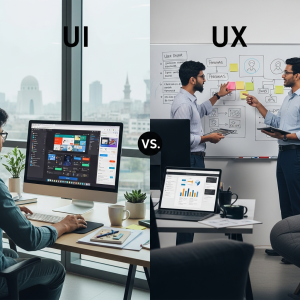
5. What’s the difference between UX and UI design?
UI (User Interface) design is focused on the visual aspects of the website—the colours, fonts, buttons, and overall look and feel. It’s about how it looks. UX (User Experience) design is focused on the overall experience a person has while interacting with the website. It’s about how it feels and works—is it easy to navigate, logical, and intuitive? A great website needs both excellent UI and UX to be successful.