Shopify vs. WooCommerce: Which E-commerce Platform is Best for Your Pakistani Business?
The e-commerce landscape in Pakistan is booming. From bustling Karachi markets to the artisan crafts of Hunza, entrepreneurs are taking their businesses online, reaching customers across the country and beyond. But the very first, and most crucial, decision you’ll make is choosing the right platform to build your digital storefront. Two names dominate the conversation: Shopify and WooCommerce.
Both are powerful contenders, but they cater to different needs, budgets, and technical skill levels. Choosing the wrong one can lead to frustration and lost sales, while the right one can become the foundation of your business’s growth. This guide is specifically designed for Pakistani entrepreneurs to help you navigate this choice, comparing Shopify and WooCommerce on the factors that matter most in our local market.
At a Glance: A Quick Comparison
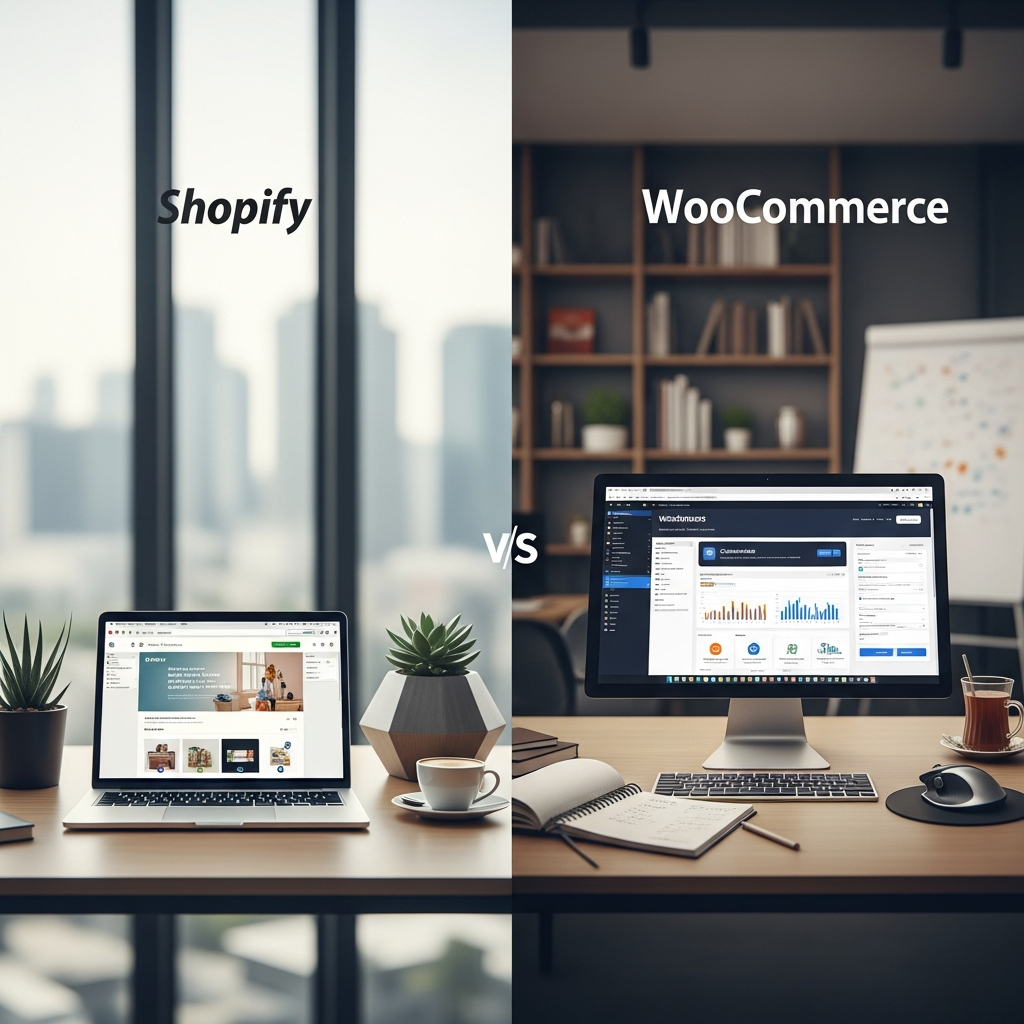
Before we dive deep, let’s look at the fundamental difference between these two e-commerce giants:
- Shopify: This is a fully hosted, all-in-one e-commerce platform. Think of it like renting a fully furnished and serviced shop in a high-end mall. You pay a monthly fee, and Shopify handles all the technical stuff—hosting, security, updates, and performance. It’s designed for simplicity and ease of use.
- WooCommerce: This is a self-hosted, open-source plugin for WordPress. It’s like buying a plot of land (your hosting) and using a powerful set of tools (WordPress and WooCommerce) to build your shop from the ground up. It’s free to use, but you are responsible for hosting, security, and maintenance. It offers unparalleled flexibility and control.
Deep Dive: Key Factors for Pakistani Businesses
Let’s break down the comparison across several critical areas to see which platform truly comes out on top for your specific needs.
Ease of Use: Getting Started Quickly
For a new business owner, time is money. A platform that’s quick to set up means you can start selling faster.
Shopify
Shopify is the undisputed champion of simplicity. Its guided setup process walks you through every step, from adding your first product to configuring your store settings. The dashboard is clean, intuitive, and designed for people who aren’t developers. With its drag-and-drop theme editor, you can build a beautiful-looking store without writing a single line of code. Everything you need is integrated into one cohesive system.
WooCommerce
WooCommerce has a steeper learning curve. It’s not a standalone platform but a plugin for WordPress. This means you first need to get web hosting, install WordPress, choose a theme, and then install and configure the WooCommerce plugin. While this process offers more control, it can be intimidating for absolute beginners. You’ll be managing different components (hosting, WordPress core, themes, plugins) which requires a bit more technical comfort.
Verdict for Pakistan: For pure, out-of-the-box simplicity, Shopify wins. If you want to launch your store this weekend with minimal technical fuss, Shopify is your best bet.
Pricing & Overall Costs: What’s the Real Expense in PKR?
Budget is a major consideration for any startup or small business in Pakistan. Here’s how the costs stack up.
Shopify
Shopify operates on a subscription model with clear, predictable monthly costs.
- Basic Plan: Starts around $29/month (~8,000 PKR). Ideal for new businesses.
- Shopify Plan: Around $79/month (~22,000 PKR). For growing businesses needing more features.
- Advanced Plan: Around $299/month (~83,000 PKR). For scaling businesses with high volume.
Additionally, Shopify charges transaction fees (typically 1-2%) if you don’t use their native Shopify Payments gateway. Since Shopify Payments isn’t fully available in Pakistan, you will have to use third-party gateways and incur these fees.
WooCommerce
The WooCommerce plugin itself is 100% free. However, “free” doesn’t mean zero cost. You are responsible for the following:
- Domain Name: Around 2,000 – 3,000 PKR per year.
- Web Hosting: This is the big variable. Shared hosting from local or international providers like Hostinger.pk or HosterPK can start as low as 800 – 1,500 PKR per month. As your store grows, you’ll need to upgrade to more expensive hosting.
- Premium Theme (Optional): While free themes exist, a good premium theme costs a one-time fee of 10,000 – 18,000 PKR.
- Premium Plugins (Optional): Some functionalities might require paid extensions (e.g., advanced booking systems, specific shipping calculators).
Initially, a WooCommerce store can be significantly cheaper to launch than a Shopify store.
Verdict for Pakistan: For the lowest initial startup cost, WooCommerce has the edge. However, Shopify offers predictable expenses that are easier to budget for long-term.
Payment Gateways: Accepting Payments in Pakistan
This is arguably the most critical factor for a Pakistani e-commerce store. How easily can your customers pay you?
Shopify
Shopify integrates with major international payment gateways like Stripe and 2Checkout, which work in Pakistan. However, integrating popular local payment methods like JazzCash, Easypaisa, or local bank transfers can be more complex. Often, it requires a third-party app from the Shopify App Store, which may come with its own subscription fees and can sometimes be less seamless than a direct integration.
WooCommerce
This is where WooCommerce shines for the Pakistani market. Because it’s open-source, dozens of Pakistani developers and payment companies have created dedicated plugins for WooCommerce. You can easily find official, often free, plugins to directly integrate:
- JazzCash
- Easypaisa
- Bank Alfalah
- HBL Konnect
- And many other local banks and services.
This direct integration provides a smoother checkout experience for your customers and is often cheaper and easier to manage for you as the store owner.
Verdict for Pakistan: WooCommerce is the clear winner. Its flexibility and wide support for local Pakistani payment gateways are a massive advantage.
Design & Customization: Creating Your Brand’s Look
Your online store’s design is your digital brand identity. You need a platform that lets you create a unique and professional-looking site.
Shopify
Shopify offers a curated selection of professionally designed themes in its Theme Store. They are all mobile-responsive and optimized for conversions. While customization is straightforward using the built-in editor, your ability to make deep structural changes is limited unless you are proficient in Shopify’s templating language, Liquid. You are working within the framework Shopify provides.
WooCommerce
With WooCommerce, the sky is the limit. It works with virtually any WordPress theme, giving you access to thousands upon thousands of options from marketplaces like ThemeForest. More importantly, you can use powerful page builder plugins like Elementor or Divi, which give you complete drag-and-drop control over every single element of your site. If you can imagine it, you can probably build it with WooCommerce.
Verdict: For ultimate control and unlimited design possibilities, WooCommerce is superior.
SEO & Marketing: Getting Found by Customers
A beautiful store is useless if no one can find it. Search Engine Optimization (SEO) is crucial for attracting organic traffic.
Shopify
Shopify has strong, built-in SEO features. It handles the technical basics like sitemaps and SSL certificates automatically. You can easily edit meta titles, descriptions, and image alt-text. The Shopify App Store is also filled with powerful marketing apps for email marketing, social media integration, and more.
WooCommerce
WooCommerce runs on WordPress, which is famous for its SEO capabilities. By installing a powerful (and often free) plugin like Yoast SEO or Rank Math, you gain granular control over every aspect of your site’s SEO. These tools provide in-depth analysis and recommendations to help you rank higher on Google. You have more power to fine-tune your SEO strategy.
Verdict: It’s a close call, but WooCommerce offers slightly more control and power for those who want to dive deep into advanced SEO tactics. Both platforms are excellent for SEO fundamentals.
Scalability & Performance: Growing Your Business
Your platform should be able to grow with you, from your first ten orders to thousands per day.
Shopify
This is a core strength of Shopify. Because it’s a hosted solution, they manage all server resources. You never have to worry about your site crashing during a big sale (like a Black Friday or Eid sale) due to a traffic spike. Shopify’s infrastructure is built to handle massive volume. Upgrading your plan is a simple click of a button.
WooCommerce
The scalability of a WooCommerce store is entirely dependent on your hosting provider. On a cheap shared hosting plan, a sudden traffic surge can slow down or even crash your site. As your business grows, you are responsible for upgrading your hosting plan—moving from shared hosting to a VPS (Virtual Private Server) or even a dedicated server. This requires more technical oversight.
Verdict: For hassle-free scalability and peace of mind, Shopify wins.
The Final Verdict: Which Platform Should You Choose?
There is no single “winner” for everyone. The best platform for you depends entirely on your business goals, technical skills, and budget.
Choose Shopify if:
- You are a beginner and want the easiest, fastest way to get online.
- You value excellent, 24/7 customer support.
- You want a predictable monthly bill and prefer not to worry about hosting or security.
- You plan to sell primarily to an international audience or are comfortable with the available international payment gateways.
Choose WooCommerce if:
- You need seamless integration with local Pakistani payment gateways like JazzCash and Easypaisa.
- You want complete creative control over the design and functionality of your store.
- You are on a tight initial budget and are comfortable finding affordable local hosting.
- You are already familiar with WordPress or are willing to learn.
Frequently Asked Questions (FAQ)
1. Is WooCommerce really free in Pakistan?
The WooCommerce plugin itself is free to download and use. However, you must pay for a domain name (your .com or .pk address) and web hosting (the server where your website files are stored). So, while the software is free, running a WooCommerce store has associated costs.
2. Which platform has better support for Cash on Delivery (COD)?
Both platforms handle Cash on Delivery very well. It can be enabled as a native payment option in both Shopify and WooCommerce with just a few clicks. It’s a standard feature for both, given its popularity in Pakistan.
3. Can I migrate from Shopify to WooCommerce (or vice-versa)?
Yes, migration is possible in both directions. There are services and plugins available that can help you move your products, customers, and order data from one platform to the other. However, the process can be complex, and it’s always best to choose the right platform from the start.
4. Which platform is better for SEO in 2024?
Both are extremely strong for SEO. Neither platform will hold you back. Success in SEO depends more on your content strategy, keyword research, and link-building efforts than the platform itself. WooCommerce offers more granular control with plugins like Yoast, which can be an advantage for advanced users.
5. Do I need a developer for a Shopify or WooCommerce store?
For Shopify, you can launch a fully functional, beautiful store without a developer. For WooCommerce, while it’s possible to do it yourself, many business owners in Pakistan hire a developer for the initial setup to ensure hosting, WordPress, and all necessary plugins are configured correctly.
Feeling overwhelmed by the options? We get it. Choosing your e-commerce platform is a big decision that sets the stage for your future success. Whether you’re drawn to the streamlined power of Shopify or the endless flexibility of WooCommerce, getting it right from the start is key.
At Bloom & Brew, we specialize in crafting high-performance e-commerce stores tailored for the unique challenges and opportunities of the Pakistani market. We can help you navigate the choice and build a digital storefront that not only looks great but also converts visitors into loyal customers. Let’s chat about your vision and build a store that brews success for your brand.